Back to: SENIOR TWO CHEMISTRY NEW CURRICULUM
Determination of pH is the most common of all analytical measurements in industrial processing. Most solutions require a specific pH for certain reactions to take place, especially in the food and beverage industries, cosmetics and pharmaceutical sector. In industries, setting pH measurements determines the quality of a product and monitors the chemical reaction. In Activity 1.2, by use of the universal indicator and the pH chart, you will get the pH values of various solutions.
Activity 1.2: Determining the pH of a solution
In this activity, you will work in groups. What you need:
| droppers soda ash solution lemon juicedilud* diluted bieach sodium hydroxide solution |
| diluted liquid soap wood ash solution universal indicator a measuring cylinder |
- universal indicator
- test tubes
- a test tube rack
- distilled water
- dilute hydrochloric acid
What to do;
- Using a measuring cylinder, measure 2 cm3 of dilute hydrochloric acid and pour it
into a beaker. - Add 2 drops of universal indicator.
- Note the colour of the solution.
- Using the pH scale in Figure 1.14, record in Table 1.5, the pH corresponding to the
colour of the solution. - Repeat procedures 1, 2 and 3 using sodium hydroxide solution, lemon juice,
diluted liquid soap, soda ash solution, diluted bleach, wood ash solution, and
distilled water - Present your results in Table /.5.
Table 1.5: colour change and the corresponding pH of different substances.
| Substance | Colour change | Corresponding pH |
| Dilute hydrochloric acid | ||
| Sodium hydroxide solution | ||
| Lemon juice Diluted liquid | ||
| soap Soda ash solution | ||
| Diluted bleach Wood ash | ||
| solution |
7. Present your results to the rest of the class.
Discussion Questions
- What is the range of pH values of acids?
- What is the range of pH values of bases?
3. What is the pH value of a neutral solution?
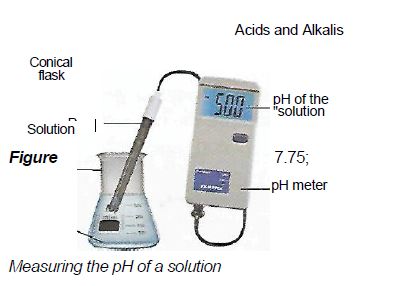
The universal indicator is a mixture of several indicators and it shows a range of rolours in acids and bases, depending on the degree of acidity or alkalinity. Some acids are more acidic than others, while some bases are more basic than others. pH can be measured directly by using a pH meter as shown in Figure 1.15
1.3 ReacJooim Between Acids siinidi Alkali Acid-base reactions form a large part of Chemistry, both in the biological and the physical Chemistry fields. Such reactions control the pH, which is one of the important aspects a chemist uses in Biochemistry and Physical Chemistry processes.
ACTIVITY 1.3 (a):Reacting an acid and a base
!n this activity, you will work in groups. What you need;
• lemon juice
• universal indicator
• sodium carbonate solution
• test tubes
What to do;
- Using a measuring cylinder, measure 2 cm3 of lemon juice and pour it into a test tube.
- Test the solution with a red litmus paper.
- Add soda ash solution, a drop at a time, and keep testing the solution with litmus paper until it just turns blue.
- Add 2 drops of universal indicator to the resultant solution in 3 above, and note the colour.
- Repeat procedures 1, 2, 3 and 4 using sodium hydroxide solution and dilute hydrochloric acid.
Discussion Questions
1. What do you observe when sodium carbonate solution is added to lemon juice?
2. What conclusion can you make regarding the colour of the resultant solution and its pH?
3. What is the colour change when the universal indicator is added to the resultant solution?
Conclusion
The reaction between an acid and an alkali is called a neutralisation reaction. This is because the products are neutrai in terms of pH. An acid reacts with a base to give a salt and water only.

Leave a comment