Back to: PRIMARY SEVEN P7 SOCIAL STUDIES SST TOPICAL QUESTION AND ANSWERS
Fold Mountains What are Fold Mountains?
✓ Fold Mountains are mountains which were formed as a result of folding.
How were Fold Mountains formed?
✓ By folding.
Name the forces that led to the formation of Fold Mountains.
✓ Compressional forces
What name is given to the sunken part of a fold mountain?
✓ Syncline
What do we call the uplifted part of a fold mountain?
✓ Anticline
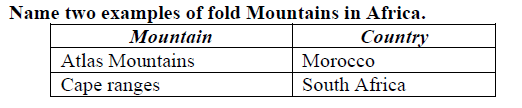
How are Drakensberg Mountains different from Atlas Mountains in terms of formation?
✓ Drakensberg mountains were formed by volcanicity while Atlas Mountains by folding
How are Drakensberg Mountains different from Atlas Mountains?
✓ Drakensberg Mountains are volcanic mountains while Atlas Mountains are Fold Mountains

Mention any three economic importance of mountains
✓ They attract tourists who bring income.
✓ They have fertile soils for crop growing.
✓ They help in rail formation.
✓ They create employment to people.
✓ They are sources of minerals.
✓ Some mountains are source of some rivers which attract tourists.
Mention any two social importance of mountains.
✓ They are used for study research.
✓ They provide shelter to wild animals.
✓ They provide rocks for building.
How are mountains politically important to African countries?
✓ They form natural borders between countries.
How do Mountains influence or affect climate?
✓ They help in rain formation.
How do mountains help in rain formation?
✓ Mountains force warm winds to rise and form rain.
Mention any four economic activities carried around highlands and mountains
✓ Crop growing
✓ Mining
✓ Quarrying
✓ Tourism
✓ Animal rearing
✓ Lumbering
Give any four disadvantages of mountains.
✓ Some mountains erupt and kill people.
✓ They make road construction difficult.
✓ They are homes dangerous wild animals.
✓ They act as rain shadow.
✓ They promote severe soil erosion.
What is a rain shadow?
✓ A rain shadow is the leeward side of the mountain which does not receive rainfall.
Mention any four problems associated or faced by people living near mountainous areas.
✓ Landslides
✓ Mudslides
✓ Soil erosion
✓ Poor transport
✓ Volcanic eruption
✓ Dangerous wild animals
Give any four possible solutions to the above problems.
✓ Use of animal transport
✓ Use of terraces to control soil erosion
✓ Use of ox-ploughing where tractors cannot work
✓ Avoid deforestation on mountain slopes
✓ Planting more trees on mountain slopes to control landslides.
✓ Constructing winding roads
Give any four ways of controlling soil erosion in mountainous areas.
✓ By terracing
✓ By contour ploughing
✓ By strip cropping
✓ By planting trees on mountain slopes
Mention any two ways mountains and highlands hinder the economic development of an area.
✓ They cause poor transport.
✓ They cause landslides which destroy property.
✓ They erupt and destroy people’s property.
✓ They act as hideout of rebels.
✓ They experience soil erosion which affects agriculture.
State any two way mountains and highlands affect transport network?
✓ They make the construction of transport routes difficult.
✓ They experience landslides which destroy transport routes.
Give any two ways of solving the problem of poor transport network in mountainous areas.
✓ By constructing winding roads.
✓ By encouraging people to keep donkeys.
Give one reason why mechanization is difficult in highland areas
✓ Highland areas are not flat.
Give any two reasons why people settle in highland and mountainous areas.
✓ Presence of fertile soils which favour agriculture.
✓ Presence of good climate which favour agriculture.
Why there are few people living in higher parts of mountains?
✓ Higher parts of mountains experience very cold conditions
✓ Transport and communication is difficult on higher parts on the mountain

Leave a comment