Back to: SENIOR TWO CHEMISTRY NEW CURRICULUM
what is an indicator An indicator is a subsistence that changes its colour in acidic and basic medium. An indicator shows one colour in an acidic medium, in different colour in a basic medium
Indicators
Cars have several indicators with specific uses.
When a motorcyclist is turning right or left , you will notice the indicator lights. What is the function of the indicator in this case?
The indicator shows the direction in which the cyclist is turning as seen in the figure below

similarly, in chemistry we use indicators, but for different purpose. Can you guess what indicators are used for in chemistry?
An indicator is a subsistence that changes its colour in acidic and basic medium. An indicator shows one colour in an acidic medium, in different colour in a basic medium
Activity 1.1(b): Obtaining an indicator from plant extracts.
If it is necessary to heat the extract in order to concentrate the indicator, do not heat those containing the flammable solvents like ethanol or propanol, over an open flame. Use a water bath or a hotplate.
What you need:
- a mortar and a pestle * beakers * a dropper
- propanol or ethanol or warm water
- a measuring cylinder
petals of morning glory / bougainvillea / hibiscus / red cabbage
What to do:
1. Cut as many petals as possible from one type of flowers, like red or purple cabbage, into small pieces.
2. Grind as many petals as possible in a mortar using a pestle to obtain a paste as shown in Figure
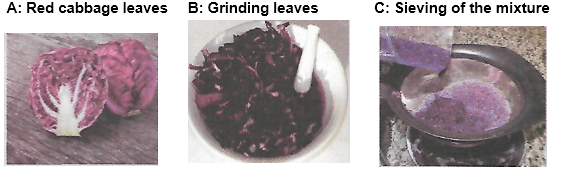
- Using a measuring cylinder, add 5 cm3of ethanol and continue grinding until a
deep colour of the flower extract appears. - Sieve the mixture into a small beaker and cover it with a filter paper. This is your
indicator, keep it safely.
shows the process of preparation of an extract.
1. In your groups, discuss why:
- propanol or ethanol is used in Activity 1.l(b).
- coloured flowers are preferred.
- the solution was covered after sieving.
2. What is the importance of grinding the red cabbage leaves?
Conclusion
The red cabbage juice extracts work as indicators. They show different colour changes in acidic, basic and neutral media.
| Activity 1,1 (c): Classifying substances as acids or bases using a plant extract indicator |
What you need:
- soap solution
- vinegar
- lemon / orange juice
- baking powder solution
- solution of banana ashes
- tea leaves
- distilled water
- test tubes
- sodium chloride (common salt)
- solution
- a test tube rack
- a measuring cylinder
What to do:
- Using a measuring cylinder, measure 2 cm3 of lemon juice and pour it into a test
tube. - Add 3 drops of the indicator that you prepared in Activity 1.1(b).
- Observe and record the colour change in Table 12.
Table 1.2; Effect of the flower extract on different substances
| Substance | Colour change when the indicator is added | Conclusion (acidic, basic or neutral) |
| Lemon juice | ||
| Vinegar | ||
| Soap solution | ||
| Tea leaves | ||
| Baking powder solution | ||
| Solution of banana ashes | ||
| Sodium chloride solution | ||
| Distilled water |
4 Repeat procedures 1 and 2 using, vinegar, soap solution, tea leaves, baking powder solution, solution of banana ashes, sodium chloride solution, and distilled water.
5. Record your results in Table 12 and conclude on the nature of the given solutions.
Discussion Questions
In groups, discuss the following:
- What was the colour of the flower extract you used?
- Which substance(s) turned the colour of the flower extract the same way
that lemon did? - Which substance(s) turned the colour of the flower extract the same way
that the baking powder solution did? - What name can be given to the flower extract Why?
- What name can be given to those substances that had an effect on the
flower extract in the same way as;
a) lemon juice b) distilled water c) baking powder solution?
Conclusion
The flower extracts showed different colour changes in acidic and basic solutions. It is reasonable to suggest plant flowers as an alternative source of indicators. They are simple, economical, and readily available for identifying acids and bases. Therefore, Chemists should exploit the importance of brightly coloured flowers within their environment This shows flexibility of the natural environment in science teaching. Read more about the indicator.
For the quiz below select the correct answer for each substance below. ( select acidic, basic, or neutral )

This notes help me alot at my humble abod